
Why Technical Skills Are Not Enough for Career Progression.
Business, Leadership and Entrepreneurship Education in Practice.
Many professionals reach a point where working harder no longer leads to progress. The challenge is no longer effort, it is capability.
When Technical Skill Is No Longer Enough.
At some point in almost every career, something changes.
The work becomes more complex.
The decisions carry more weight.
Other people begin looking to you for direction.
Your competition for promotion becomes stronger.
Or you begin thinking about changing direction entirely.
This is often the moment many professionals discover a gap.
Technical expertise is often what allows many people to begin their careers.
But as responsibilities grow, success increasingly depends on broader capabilities, like the ability to understand organisations, guide people, recognise opportunities and make sound decisions in complex situations.
These capabilities sit at the intersection of business thinking, leadership capability and entrepreneurial mindset.
Across Australia’s 2.6 million businesses, organisations increasingly need people who can combine technical expertise with broader business understanding and leadership capability.
The professionals who progress are rarely just the most technically capable.
They are the ones who can:
Think strategically.
Communicate clearly.
Lead people effectively.
Make sound decisions under pressure.
For many professionals, developing these capabilities becomes the next step in their career journey, often through structured learning such as a Diploma of Leadership and Management.
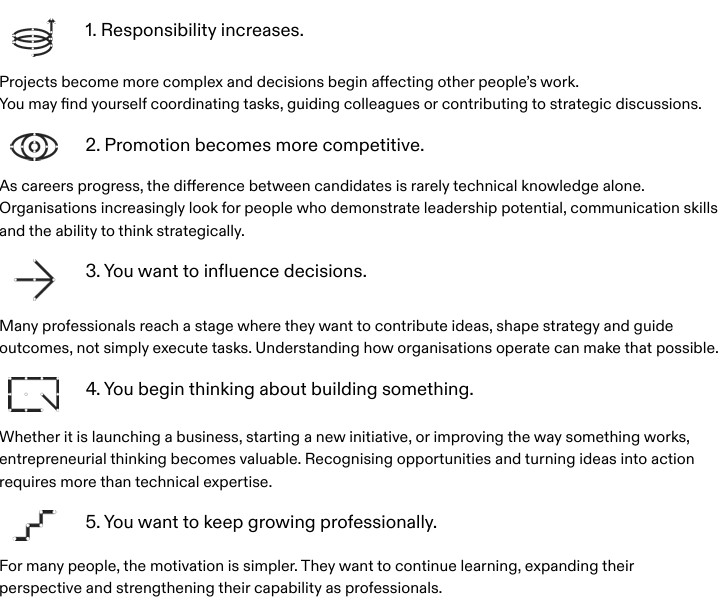
Five Moments When Professionals Start Thinking About Business Study.
Most people do not wake up one morning and decide they want to study business. Usually something happens first.
A project becomes more complex.
A team situation becomes difficult.
A decision carries more weight than expected.
Gradually, the skills that once felt optional begin to matter more.
These are some of the moments when professionals begin to realise their career may require more than technical expertise.
What Business Education Actually Changes.
When people hear “business study”, they often imagine spreadsheets, finance models or strategy frameworks.
Those things are certainly part of it.
But the deeper value lies somewhere else.
You begin to recognise patterns in how organisations operate.
You see how strategy connects to everyday operations.
You understand how incentives influence behaviour.
You start noticing how decisions made in one part of an organisation affect outcomes elsewhere.
Over time, this way of thinking becomes instinctive.
Instead of reacting to problems, you begin analysing them.
Instead of focusing only on individual tasks, you begin understanding the broader system around them.
This shift in perspective is often what allows professionals to move from simply doing work to shaping outcomes.
Leadership Is Mostly About People.
Many professionals assume leadership is primarily about authority or position.
In reality, leadership appears in much smaller, everyday moments.
A difficult conversation with a colleague.
A team member struggling with performance.
A disagreement about priorities.
A decision that affects other people’s work.
In these situations, technical expertise alone is rarely enough.
What matters more is judgement.
How you listen.
How you communicate.
How you respond under pressure.
Doing the work builds credibility.
Understanding people builds leadership.
The most effective professionals develop both.
A Practical Leadership Lesson.
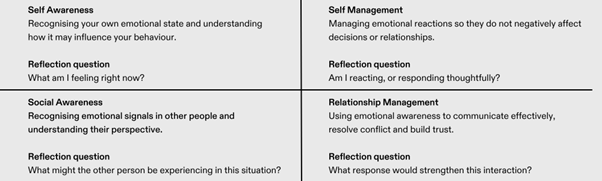
Emotional Intelligence
One of the most widely recognised capabilities in modern leadership is emotional intelligence.
Emotional intelligence refers to the ability to recognise, understand and manage emotions in yourself and in others.
While technical knowledge and experience remain important, research consistently shows that leadership effectiveness is strongly influenced by how people communicate, respond to pressure and navigate complex interpersonal situations.
Emotional intelligence helps professionals do exactly that.
A commonly used framework describes emotional intelligence through four core capabilities.
A Simple Leadership Tool: The Leadership Pause
In challenging situations, many leaders use a simple technique known as the leadership pause.
Before responding in a difficult conversation or decision, pause briefly and ask yourself three questions.
What am I feeling right now?
What might the other person be experiencing?
What response will create the best outcome?
Even a brief pause can significantly improve communication, decision-making and leadership effectiveness.
The Entrepreneurial Mindset.
Entrepreneurship is often associated with starting a business.
But the mindset behind entrepreneurship is valuable in almost any professional role.
Entrepreneurial thinking is about recognising opportunities, solving problems creatively and taking initiative when something can be improved.
Many organisations rely on people who can think this way.
They notice inefficiencies.
They recognise possibilities.
They look for ways to create value rather than simply maintaining the status quo.
In this sense, entrepreneurship is not just about launching companies.
It is about seeing possibilities where others see problems.
Across Australia, small businesses play a significant role in the economy.
There are more than 2.6 million actively trading businesses, and over 97% of them are small businesses.
Source
Australian Bureau of Statistics
Counts of Australian Businesses
ABS link
Developing an entrepreneurial mindset helps professionals recognise opportunities, take initiative and turn ideas into action, whether within an organisation or through their own ventures.
Education and Career Development in Australia.
Across Australia, millions of professionals continue developing their skills while working.
Learning is no longer something most people complete once early in life. It has increasingly become an ongoing part of career development.
As industries evolve and technology changes the nature of work, many professionals continue strengthening their knowledge and capability throughout their careers.
Recent data from the Australian Bureau of Statistics highlights how widespread this has become.
More than two million Australians are currently studying while also participating in the workforce.
Around two-thirds of Australians aged 15–74 now hold a non-school qualification, including certificates, diplomas and degrees.
People with post-school qualifications have significantly higher employment rates, with around 80% employed compared with approximately 58% of those without a qualification.
These figures highlight an important shift.
Professional learning has become a normal part of modern careers.
For many professionals, developing new skills and perspectives is no longer an occasional activity, it is part of staying capable, adaptable and competitive in a changing world.
Source
Australian Bureau of Statistics
Education and Work, Australia
ABS link
Connecting the Dots
Careers rarely follow a straight line.
Most professionals begin with specialised skills. Over time their responsibilities expand. They guide projects, influence decisions and navigate increasingly complex situations.
At some point many people realise that success requires more than expertise alone. It requires broader capability. Looking back, education often becomes one of the dots that helped clarify the bigger picture.
Learning provides frameworks that help professionals understand organisations more clearly, lead others more effectively and approach challenges with greater confidence.
Explore our courses.
If you're looking to build these capabilities in a structured way, explore our nationally recognised qualifications below:
BSB40120 Certificate IV in Business
BSB40520 Certificate IV in Leadership and Management
BSB40320 Certificate IV in Entrepreneurship and New Business
BSB50120 Diploma of Business
BSB50420 Diploma of Leadership and Management
BSB50420 & BSB50120 Double Diploma: Diploma of Leadership & Management and Diploma of Business